
Most businesses in Oman install access control and time attendance reactively — after a break-in, an audit finding, or a payroll dispute. This guide covers the main system types, how the two work together on the same hardware, key questions to ask vendors, and what a professional installation looks like.
Access Control and Time Attendance Systems in Oman: A Practical Guide for Businesses
Most businesses in Oman install access control and time attendance reactively — after a break-in, an audit finding, or a payroll dispute. This guide covers the main system types, how the two work together on the same hardware, key questions to ask vendors, and what a professional installation looks like.
Access control and time attendance are two of those systems that businesses in Muscat often install reactively - after a break-in, an audit finding, a payroll dispute, or once headcount grows past the point where a shared key and a paper sign-in sheet are workable. Done well, it should be the opposite: a planned layer of your operations that scales with the business and, in most cases, does both jobs from the same hardware.
This guide walks through the main system types available in Oman, how access control and time attendance relate to each other, what to ask vendors before you commit, and what a properly specified installation actually involves.
Why access control is different from "just a lock"
A traditional lock and key answers one question: can this person get through this door. Access control answers several more:
- Who went through this door, and when
- Which doors is this person allowed to use, and during which hours
- What happens automatically if someone tries to force entry, tailgate, or use a credential that has been revoked
- How do we remove someone's access the moment they leave the company, without rekeying anything
For any business with more than a handful of staff, multiple entry points, or areas that need restricted access (server rooms, cash offices, pharmacies, warehouses), these questions matter more than the cost of the hardware itself.
The main system types in the Omani market
Card and fob (proximity/RFID) systems. The most common commercial option. Reliable, inexpensive per credential, and well understood by installers across Oman. The main weakness is that cards get shared, lost, or cloned if the system uses older low-frequency tags rather than encrypted high-frequency ones.
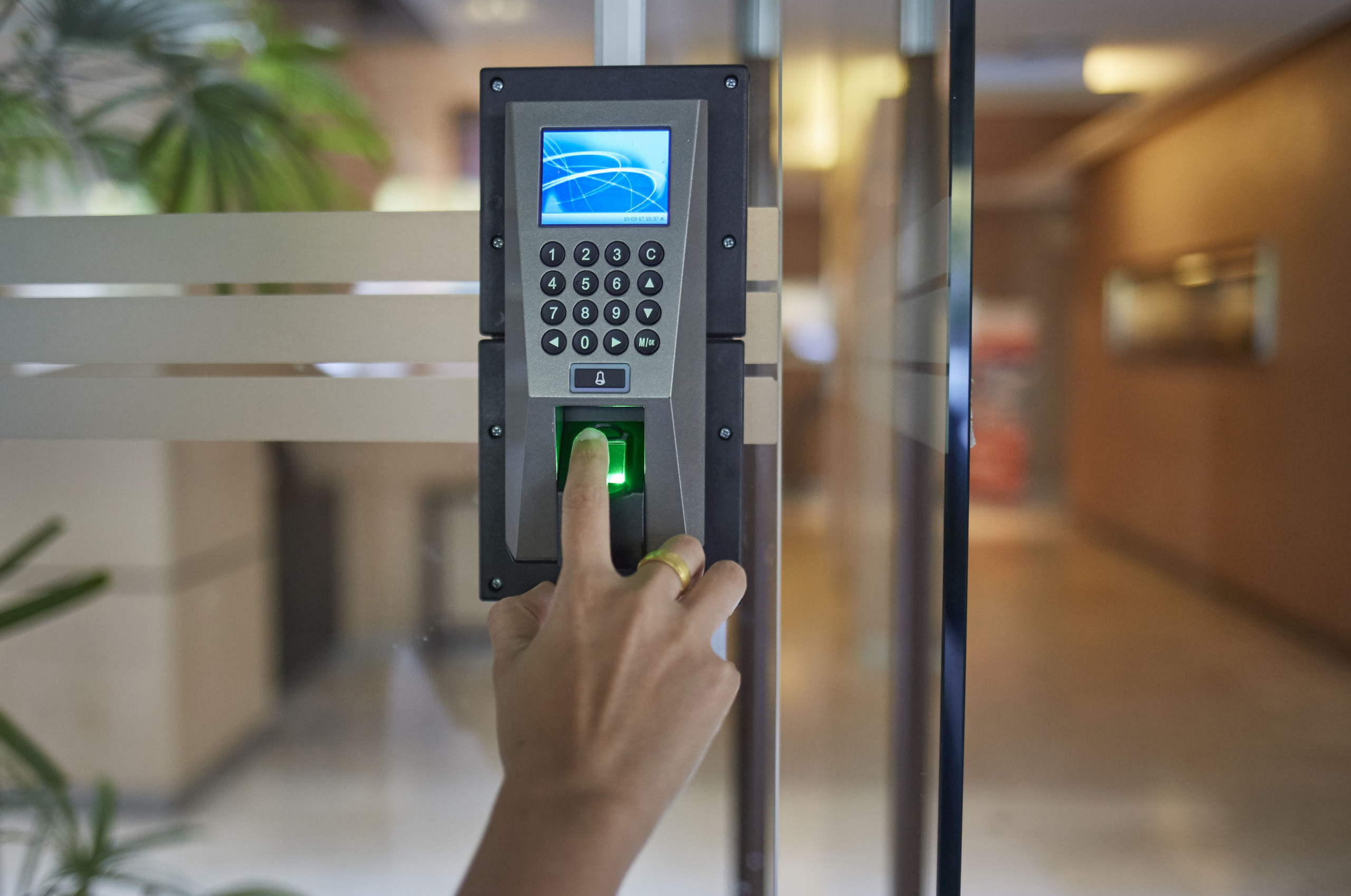
Biometric readers (fingerprint, facial recognition). Removes the sharing problem entirely - a credential cannot be lent to a colleague. Facial recognition adoption has grown quickly in Muscat commercial buildings over the last few years, partly because it is contactless and fast at high-traffic entrances. Fingerprint readers remain common in factories and warehouses where staff wear gloves less often.
PIN keypads. Cheapest option, but the weakest from a security standpoint since codes are easy to share and hard to audit individually. Best used as a secondary factor alongside a card or biometric reader, not as the sole method for a sensitive area.
Mobile credentials. Access via a smartphone app or Bluetooth/NFC. Growing in newer commercial developments in Muscat, particularly where the building already runs a broader smart-building platform. Convenient, but dependent on staff having a charged, compatible phone - worth having a backup credential type for critical doors.
Vehicle access (gate barriers, automatic number plate recognition). For sites with vehicle entry - warehouses, compounds, labour camps, gated business parks - ANPR-linked barriers are increasingly standard, logging vehicle movement alongside personnel movement.
Time attendance: the same hardware, a different job
Most of the credential types above - card, fob, fingerprint, facial recognition - can serve double duty as a time attendance system, logging when staff clock in and out rather than just which doors they pass through. In practice, many businesses in Oman install one system that handles both.
Why combine them. A single reader at the entrance does the security job (only authorised staff get in) and the HR job (payroll gets an accurate, tamper-resistant record of hours worked) at the same time. This avoids the double cost of a separate access reader and a separate biometric time clock, and it removes the manual step of reconciling two systems.
Where a standalone time attendance system still makes sense. Sites with open access (retail floors, some warehouses) or businesses that already have a functioning access control system but no attendance tracking sometimes add a dedicated time clock at a single point - a staff entrance or a supervisor's office - rather than re-wiring every door.
What to check in a combined system
- Shift and overtime rules. Confirm the software can handle your actual shift patterns (rotating shifts, split shifts, Friday/weekend rules common in Oman) rather than a fixed 9-to-5 template.
- Payroll integration. Ask whether attendance data exports directly into your payroll or HR software, or whether someone will be manually re-entering hours each month. Direct integration is worth paying for once staff numbers pass a few dozen.
- Exception handling. Late arrivals, early departures, forgotten clock-outs, and manual overrides need an approval workflow, not just a raw log that HR has to interpret by hand.
- Ministry of Labour compliance. Attendance records may be requested during labour inspections or disputes. Confirm the system retains data for a sufficient period and produces reports in a format your HR team can present if asked.
- Multi-site consolidation. If you operate more than one location in Oman, ask whether attendance data from all sites rolls up into a single dashboard, rather than requiring someone to check each site's system separately.
Brands commonly available in the Omani market
Hardware brands are more commoditised than the design and integration work around them, but knowing the main players helps you sense-check a proposal:
- HID Global — widely used for card and mobile credential readers, particularly in banking, government, and larger commercial buildings.
- ZKTeco — a common choice for biometric (fingerprint and facial) readers, especially in mid-market commercial and industrial installs.
- Suprema — higher-end biometric and facial recognition readers, often specified for corporate offices and premium developments.
- Hikvision and Dahua — primarily CCTV manufacturers, but both also produce access control readers and controllers, which some installers favour for easier integration with an existing camera system from the same brand.
- dormakaba — door hardware, electric strikes, and closers, frequently paired with any of the above reader brands rather than competing directly with them.
- Honeywell — present in integrated building security platforms, particularly where access control is one part of a wider building management system.
None of these brands is inherently "the right choice" - the reader and controller matter less than whether the installer designs the door schedule correctly, integrates it with your other systems, and supports it afterward. Treat brand names in a proposal as one data point, not the deciding factor.
Six questions to ask before choosing a vendor
1. Is this a standalone system or a networked one?
Standalone locks manage each door independently, with no central log or remote control. Networked systems report to a central server or cloud platform, giving you a live audit trail and the ability to revoke access instantly from anywhere. For anything beyond a single door, networked is worth the extra cost.
2. How does the system handle a lost credential or a departing employee?
Ask the vendor to demonstrate, in the proposal meeting, how long it takes to deactivate a card or biometric profile. It should be immediate, not "the next time someone visits the site to reprogram the reader."
3. Can this integrate with our CCTV and fire systems?
A well-designed access control setup should be able to trigger nearby cameras to record on a forced-door alarm, and should release doors automatically on a verified fire alarm signal, in line with civil defence requirements. If a vendor treats access control as an isolated system, ask why.
4. What happens during a power cut?
Fail-safe locks release when power is lost (required on fire escape routes); fail-secure locks stay locked. Your installer should specify which doors get which behaviour, and how long the battery backup covers the reader and controller during an outage.
5. Where is the data stored, and who can see it?
Access logs contain personal movement data. Ask whether the platform is cloud-hosted, on-premise, or hybrid, and where the servers are physically located. For regulated sectors (banking, healthcare, government-adjacent work), data residency can be a compliance question, not just a technical one.
6. What is the cost per credential, and per additional door, if we expand?
Get pricing for adding 10 more users and one more door next year, not just for the current scope. Some platforms charge ongoing software or cloud fees per credential; others are a one-time licence. This materially affects total cost of ownership over a 5-year horizon.
Red flags to watch for in proposals
No mention of fail-safe vs fail-secure behaviour. This is a life-safety detail, not an afterthought, and any installer working on commercial premises in Oman should address it without being asked.
Vague integration claims. "Yes, it integrates with your CCTV" without naming the protocol (ONVIF, a specific API, or a shared platform) usually means it does not, in practice.
No mention of backup power or battery runtime. A door controller with no backup fails locked - or unlocked - the moment the power goes.
Single point of failure in credential management. If only one person at the vendor can push updates to the system, you are exposed if that person is unavailable during an incident.
No discussion of tailgating or door-forced alarms. Basic card access without any anti-tailgating measure (turnstile, mantrap, or camera-verified single entry) is common but worth flagging as a known limitation rather than a surprise later.
What a professional installation looks like
Site assessment. The installer maps every entry and exit point, identifies which doors need which credential type and fail-safe behaviour, and checks existing door hardware (many older doors need new strikes or closers to work with electronic access).
System design. A door schedule is produced - a list of every controlled door, its credential type, its fail-safe/fail-secure setting, and its integration points with CCTV or fire systems.
Cabling and hardware installation. Readers, controllers, and door hardware are installed with proper cable management, and controllers are placed in secure locations, not in a cupboard anyone can access.
Software configuration and testing. User groups, time schedules, and door groups are configured, and every door is tested for both normal access and forced-entry alarm response.
Handover and training. Your admin staff are trained to add and remove users themselves, without needing to call the installer for routine changes. This is worth confirming explicitly - some vendors keep this control in-house as a way of generating ongoing service calls.
Oman-specific considerations
Heat. Outdoor readers on gates and perimeter doors need an appropriate IP rating and a wide operating temperature range; budget indoor-rated readers fail quickly when mounted outside during summer months.
Labour and staff turnover. Sectors with higher turnover (construction, hospitality, retail) benefit from systems where onboarding and offboarding a credential takes minutes, not a scheduled maintenance visit.
Integration with existing gate automation. Many commercial and residential compounds in Muscat already run automated gates or barriers. Confirm your access control vendor can integrate with, rather than duplicate, that existing infrastructure.
Civil defence and fire egress requirements. Any door on a designated fire escape route must fail safely open on a fire alarm signal. Confirm this is addressed in the design before installation, not discovered during an inspection.
Checklist: Evaluating an access control and time attendance proposal
- Specifies fail-safe vs fail-secure behaviour per door
- Confirms integration with existing CCTV and fire alarm systems
- States backup power/battery runtime for controllers and readers
- Clarifies where access and attendance log data is stored and who can access it
- Provides pricing for future expansion, not just current scope
- Includes admin training so you can manage users independently
- Addresses tailgating or forced-door alarm handling
- Confirms IP rating and temperature range for any outdoor hardware
- Confirms shift/overtime rules and payroll export match your actual HR process
- Confirms multi-site attendance data rolls up into one dashboard, if applicable
Access control and time attendance are a long-term investment in how your business manages people, not just doors and clock-ins. The right system should still be easy to expand and manage years after installation, without locking you into a single vendor for routine changes.
Need a site assessment for your facility in Muscat or elsewhere in Oman?
Contact the USTS team